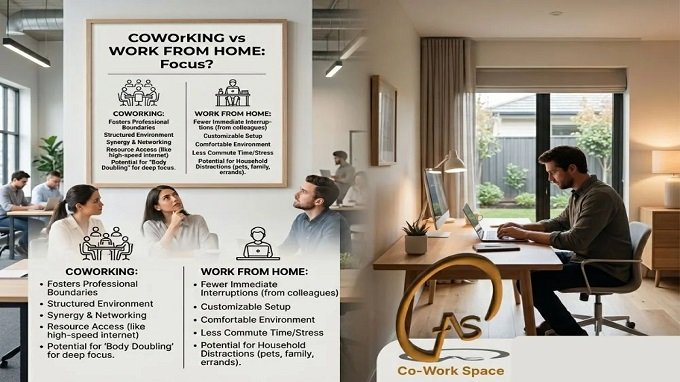
Coworking vs Work From Home: What’s Better for Focus?
The modern work culture is really dynamic, and one thing that comes up constantly is the question, at what point do we work best? Is it the comforts of home or the organization of a coworking space?
Coworking spaces are once again gaining momentum, whereas working at home due to the pandemic has become the new reality. And the biggest reason is just plain and simple focus and productivity.
We can break this down in a real-world, practical way so that you can choose what really works in your world.
Work From Home (WFH)
Working at the comfort of your home is a dream, isn’t it? No traveling, no schedule, and working in your pyjamas. Reality is usually otherwise.
Pros of Work From Home
Comfort & Convenience
You are alone and this can be cool and stress-free.
No Travel Time
You save many hours per day by not being in traffic.
Flexible Routine
You are able to create your individual timetable.
Cons of Work From Home
Too Many Distractions
TV, telephone, relatives or even the bed- they all vie to catch your eye.
Lack of Work-Life Boundaries
Personal life and work tend to intertwine and it is more difficult to disconnect.
Isolation
You lack social interactions and networking.
Low Motivation
It is difficult to remain disciplined in the absence of a professional environment.
Reality check: Unfortunately, there are a lot of individuals who begin well with WFH but over time, they lack consistency and attention.
What is a Coworking Space?
A coworking space is a shared office where professionals, freelancers, startups, and even remote employees work together in a professional environment.
It’s not just about desks and Wi-Fi—it’s about creating a focused work atmosphere.
Why Coworking Spaces Improve Focus
1. Professional Environment = Serious Mindset
When you step into a coworking space, your brain automatically switches to “work mode.”
Unlike home, where relaxation dominates, coworking spaces are designed to:
- Minimize distractions
- Encourage discipline
- Boost concentration
The environment plays a huge role in productivity.
2. Fewer Distractions Compared to Home
At home:
- Someone might call you for small tasks
- Social media becomes tempting
- Household chores interrupt your flow
In a coworking space:
- Everyone around you is working
- The atmosphere is calm and focused
- You naturally stay on track
3. Better Work-Life Balance
One of the biggest issues with WFH is that work never ends.
Coworking solves this:
- You go to a workspace
- You finish your work
- You leave work behind
This clear boundary improves both mental health and productivity.
4. Networking & Motivation
Working alone can feel demotivating over time.
Coworking spaces offer:
- Interaction with like-minded professionals
- Opportunities to collaborate
- Exposure to new ideas
Even seeing others working hard can push you to stay focused.
5. Dedicated Work Setup
At home, your setup might not always be ideal:
- Uncomfortable chairs
- Poor lighting
- Internet issues
Coworking spaces provide:
- Ergonomic seating
- High-speed internet
- Meeting rooms
- Quiet zones
A proper setup directly improves focus and efficiency.
When Work From Home Works Better
WFH is not bad—it just depends on the situation.
It works well if:
- You are highly disciplined
- You have a separate home office
- Your work requires deep, uninterrupted thinking
- You prefer working alone
For example:
- Writers
- Designers
- Developers
But even in these cases, many professionals choose hybrid working (mix of home + coworking).
Coworking vs Work From Home: Quick Comparison
|
Factor |
Work From Home |
Coworking Space |
|
Focus Level |
Medium to Low |
High |
|
Distractions |
High |
Low |
|
Work-Life Balance |
Poor |
Better |
|
Social Interaction |
Minimal |
Good |
|
Motivation |
Fluctuates |
Consistent |
|
Setup Quality |
Depends |
Professional |
Winner for focus: Coworking space
The Psychological Difference
Let’s talk about something deeper—your mindset.
At home:
- Your brain associates the space with relaxation
- It’s harder to stay disciplined
In a coworking space:
- Your brain associates the environment with productivity
- You automatically behave more professionally
This psychological shift is often the biggest reason why coworking improves focus.
Hybrid Model: The Best of Both Worlds
Many professionals today are choosing a smart approach:
3–4 days coworking + 1–2 days work from home
Why this works:
- You get focused workdays
- You still enjoy flexibility
- You avoid burnout
This balance is becoming the future of work.
Who Should Choose Coworking?
Coworking is ideal for:
- Freelancers
- Startup founders
- Remote employees
- Digital marketers
- Consultants
- Students preparing for competitive exams
If focus is your priority, coworking is a strong choice.
Who Should Stick to Work From Home?
WFH works if:
- You have a strong routine
- You don’t get distracted easily
- You prefer solitude
- Your work doesn’t require collaboration
Final Verdict: What’s Better for Focus?
If we talk purely about focus and productivity, coworking spaces clearly have the upper hand.
They provide:
- Structure
- Discipline
- Professional environment
- Motivation
Work from home offers comfort—but comfort doesn’t always lead to productivity.
Conclusion
At the end of the day, the best workspace depends on your personality and work style. But if you’ve been struggling with distractions, lack of motivation, or poor work-life balance, it might be time to rethink your setup.
Trying a coworking space—even for a few days a week—can completely change the way you work.
Because sometimes, all you need to improve focus is not more effort…
but the right environment.