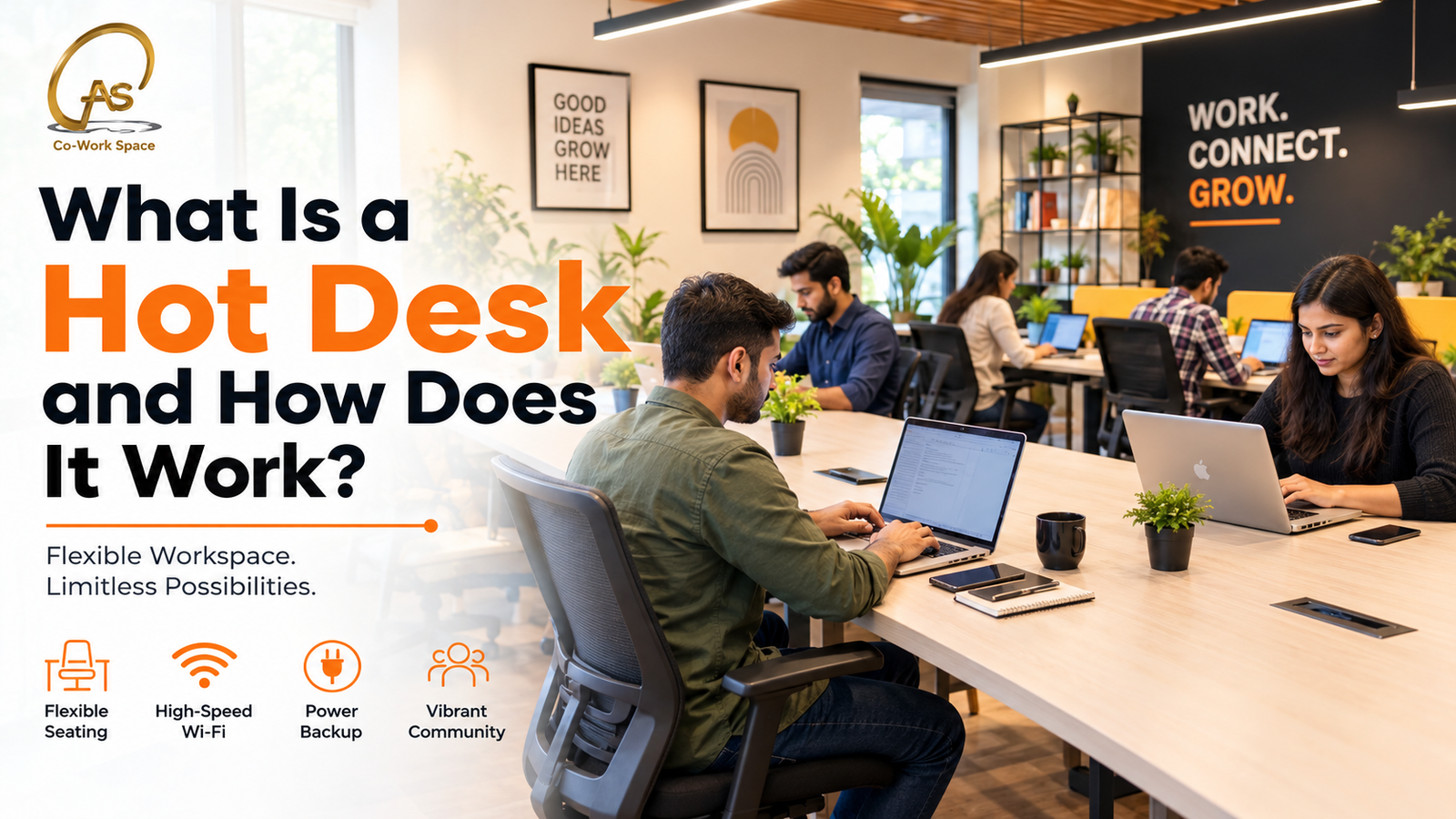
What Is a Hot Desk and How Does It Work?
Published: 2026 by Ojas Coworking.
Quick Answer
What is a hot desk? It's a desk that doesn't belong to anyone. You walk in, pick a free one, work for the day, and when you leave, someone else can use it. You'll find hot desks in coworking spaces and in plenty of offices where not everyone comes in every day.
This guide answers the question "what is a hot desk" in plain language, then goes a little further: how it works, how it compares with a dedicated desk, the good and the not-so-good, and who it actually suits.
What Is a Hot Desk?
A hot desk is a work desk you use for a while without owning it. You sit down at whichever one is free, work for the day (or the hours you've booked), and clear it when you leave. The setup is basic: a table, a chair, a power socket and internet.
People use the term "hot desking" in two slightly different ways:
• • In coworking spaces: members pick any open desk in the shared area. Wi-Fi, power and common facilities usually come with the plan.
• • In offices: the company has fewer desks than employees, so people choose a desk when they arrive, often by booking one through an app.
The idea is the same in both: you use the space when you need it instead of reserving it for good.
How Does Hot Desking Work?
Every place runs it a little differently, but the usual flow goes like this:
1 • Pick a plan or follow the policy. In a coworking space, that's a day, week or month pass. In an office, it's the company's desk-sharing rule.
2. • Check in. Some places use an app or a reception desk. Others are simply first come, first served.
3. • Choose a desk. Some spaces let you book a particular desk ahead of time. Others don't.
4 • Get on with your work. Internet, power and common areas are normally included, and some places add meeting rooms or printing.
5. • Clear up when you leave. Take your things with you or put them in a locker so the next person gets a clean desk.
Hot Desk vs Dedicated Desk vs Private Office
|
|
Hot Desk |
Dedicated Desk |
Private Office |
|
Assigned to you |
No |
Yes |
Yes |
|
Same seat every day |
Not guaranteed |
Yes |
Yes |
|
Storage for belongings |
Usually limited |
Usually available |
Yes |
|
Privacy |
Low |
Medium |
High |
|
Flexibility |
High |
Medium |
Lower |
|
Best for |
Occasional or flexible work |
Regular daily work |
Teams or confidential work |
Need the same seat every day and somewhere to leave your things? A dedicated desk suits you better. If your week looks different every time, a hot desk makes more sense.
Hot Desking vs Hotelling
People often use these two terms as if they were the same thing. With hot desking, you take any free desk when you arrive. With Hotelling, you reserve a specific desk or room for a set time in advance. Hotelling is more common in corporate offices, while hot desking is the term you'll hear more in coworking spaces.
Hot Desk vs Coworking Space vs Serviced Office
These three get mixed up a lot, but they're different things. A coworking space is the whole shared environment. A hot desk is one kind of seat inside it. A serviced office is a furnished private office, usually rented by a team on a flexible term, with extras like reception and cleaning. Put simply: the hot desk is the seat, the coworking space is the building around it, and the serviced office is a private room.
Benefits of Hot Desking
Flexibility. Limit your use of the workstation to just those days when you need it.
Lower cost. You pay for a shared desk, not an entire office, because this makes more sense if you do not use a desk every single day.
A change of scene. If working from home leaves you distracted, a proper workspace helps you switch into work mode.
Meeting new people. You end up working near people from different fields, and conversations tend to happen.
Less wasted space for companies. Offices don't pay for empty desks on days when half the team works remotely
Drawbacks of Hot Desking
•
No personal space. You can't leave your stuff out or set up the desk your way.
• Busy days. When the space fills up, a free desk (or a quiet one) can be hard to find.
• Less privacy. An open area isn't great for confidential work or long calls.
• Daily packing. You set up and pack away every single day.
• Hard to sit with your team. Colleagues won't always end up next to each other.
• Shared surfaces. Everyone needs to keep the desk clean, and not everyone does.
Common Myths About Hot Desking
People who search "what is a hot desk" often run into a few common myths:
• "It's only for startups." Freelancers, remote employees, consultants and large companies all use hot desks.
• "You'll never find a seat." It depends on the space, but booking systems and capacity limits make this much less of a problem than people expect.
• "It isn't secure." Most spaces have lockers, controlled entry and clean-desk rules, and you can always keep valuables with you.
• "Productivity always drops." Not necessarily. It depends on the person and on how well the space is run. A clear system helps; a messy one frustrates everyone.
Who Is Hot Desking Suitable For?
Hot desks tend to work well for:
• • Freelancers and consultants
• • Remote and hybrid employees
• • Early-stage founders
• • Frequent travellers
• • Sales teams who are mostly out of the office
It's usually not a good fit if you handle sensitive documents, need specialised equipment, or like the exact same setup every morning.
Hot Desking for Companies: How to Set It Up
Hot desking can cut down on unused space, but it only works with a bit of planning:
1. • Look at real attendance. It makes sense when fewer people are in the office than there are desks.
2. • Keep booking simple. A shared calendar or a desk-booking tool saves arguments about who sits where.
3. • Give people storage. Lockers or small personal trolleys let staff keep their things somewhere.
4. • Set a clean-desk rule. Every desk should be cleared at the end of the day.
5. • Let teams sit together. Allow people to book desks in the same zone when they need to work side by side.
6. • Ask for feedback. After a few weeks, find out what's working and change the rules.
How to Choose a Good Hot Desk
If you're comparing a few places, look past the location and check the practical stuff:
• • Internet: test the speed during busy hours, not only when the place is empty.
• • Noise: drop in at different times of day and see how loud the shared area gets.
• • Comfort: check the chair, desk height, lighting and ventilation.
• • Power: Find sufficient sockets and a backup in case of power failures.
• • Meeting rooms: enquire about their inclusion or separate billing.
• • Hours: make sure that the timing suits your needs.
• • Trial: Try it out for one day before deciding on a longer commitment.
What Affects the Price of a Hot Desk?
Prices differ from one place to another. The following are the main factors affecting prices:
• • Location: Places that are central or connected tend to be expensive.
• • Duration: The costs for a day pass, a week pass, and a month pass vary.
• • Access hours: Limited hours and 24/7 access may affect the price.
• • What's included: internet, time for meeting rooms, printing and snacks.
• • Extra charges: Taxes, printing, and additional meeting room time could be charged separately.
When choosing between alternatives, consider the extras rather than the advertised figure only.
What to Carry for a Hot Desk Day
Since there's no fixed desk, a small kit saves you time: a laptop and charger, headphones, a notebook, a water bottle, a power adapter if you need one, and a lock for the locker.
Hot Desk Etiquette
Shared desks work best when everyone follows a few simple habits:
• • Clear your desk and take your things when you leave.
• • Don't "save" a desk with a bag if you're going to be away for a while.
• • Take phone and video calls in designated areas or phone booths.
• • Keep your voice and speakerphone down.
• • Keep food and drinks tidy.
• • Wipe down shared surfaces if the space asks you to.
Frequently Asked Questions
What does hot desk mean?
A hot desk is a shared desk that isn't assigned to a particular person. You use whichever one is free.
What is a hot desk in simple words?
It's sitting at any free desk instead of having your own fixed one.
Is a hot desk the same as coworking?
Not quite. Coworking is the wider idea of a shared workspace. A hot desk is one type of seat within it, next to dedicated desks and private offices.
Will I get the same desk every day?
Usually not. If you want the same seat daily, go for a dedicated desk.
What is the difference between hot desking and hotelling?
Hot desking is usually first come, first served. Hotelling means booking a specific desk in advance.
Is hot desking good for productivity?
It all depends on the individual and the environment. While some individuals love the flexibility of it all, others thrive best in a set environment.
Can a company use hot desking?
Yes. Many do, especially when employees only come in a few days a week. It works best with a clear booking system, lockers and shared rules.
Final Thoughts
What then is a hot desk? It is an adjustable and shared mode of working without a fixed workstation. This type of station is best suited for individuals who have a fluctuating schedule each week and don’t require storage space or privacy. For those individuals who need privacy or a fixed desk, a dedicated station would be more appropriate.
Want to see how a hot desk works in a real coworking setup? You can read about the hot desk space at Ojas Coworking.